Bulletin № 001 · NY · PA · est 2017
Family-owned environmental testing & consulting across New York & Pennsylvania.
Mold, asbestos, radon, lead, indoor air quality, and environmental assessment services — with detailed reporting, laboratory analysis, and a clear scope of work to rectify the problem. Unbiased findings and professional recommendations without conflict of interest. Every consultant is either a Board-Certified Indoor Environmental Consultant (CIEC) or Industrial Hygienist.
Why are you here today
Five paths. One protocol.
Pick the path that matches your situation. A buyer chasing a closing. An attorney building a case. A homeowner worried about symptoms. We run the same protocol on all five.
Need something specific?
Just need mold testing, asbestos, VOC, radon, or one of our other services? View the full library.
48-Hour Appointment
Most tests scheduled within 48 hours of your call. Same-day for emergencies.
Family Owned & Operated
Founded in 2017 by Mason Bridges. The same family answers the phone and walks the property.
Independent — No Conflict
We do not perform testing and removal on the same project in NY. Findings stay unbiased.
CIEC / IH Credentialed
Board-Certified Indoor Environmental Consultant. NYS Asbestos & Mold Inspector. AIHA labs.

AIHA · NVLAP · NELAP
Accredited Laboratory Partners
Why Choose Us
Straight answers from the
people who took the sample. No upsell.
Most environmental companies will test your home, then sell you the remediation. We don't. Our reports are independent — built to hold up at a closing table, an insurance claim, or with a regulator.
Evidence, not opinions
Every recommendation we make is backed by an instrument reading or a laboratory result. If we can't measure it, we say so.
Independent reports
We don't bundle testing with remediation. When we test, we test — so the results stay independent and trustworthy.
Speed without shortcuts
48-hour appointments and 24-hour lab turnaround are our baseline — never at the expense of protocol or care.
Licenses & Accreditations
Credentialed. Not just licensed.
Most NY inspectors hold only the basic state mold license. Mason Bridges holds a board-level certification recognized nationally, plus state inspector licenses for asbestos and mold. Engagements involving industrial hygiene are conducted with or supervised by an IH.
Credential
Board-Certified Indoor Environmental Consultant (CIEC)
Council-certified Indoor Environmental Consultant credential — issued by the American Council for Accredited Certification (ACAC). Establishes Mason as a recognized Indoor Environmental Consultant.
Credential
NYS Asbestos Inspector Certification
New York State Department of Labor certification authorizing asbestos inspection and survey work in NY. Required under NYS Industrial Code Rule 56.
Credential
NYS Mold Assessor / Mold Inspector License
Licensed under New York State Article 32 to perform mold assessments. NY law requires complete separation between assessor and remediator on the same project.
Credential
Industrial Hygiene professionals (CIEC / IH)
Engagements involving industrial hygiene review (mycotoxin interpretation, CIRS-protocol testing, occupational exposure assessment) are conducted with or supervised by an Industrial Hygienist.
Certifications & Accreditations
ACAC · Board-Certified
Accrediting Body
NYS DOL
Asbestos Inspector
Licensed · New York
State License
NYS Article 32
Mold Assessor
Licensed · New York
State License
Lab partners:AIHA-LAP · NVLAP · NELAP-accredited laboratories — accreditations held by the labs we partner with.
No Conflict of Interest · New York State
We do not perform both testing and removal on the same NY project.
Independent inspection findings depend on independence. When remediation is needed, we hand off a clear scope of work to a qualified contractor — never one we also bill for the removal. In Pennsylvania we offer mitigation through a sister operation, but we never bundle assessment + remediation on the same project.
A Small Family Business
Consulting with a family — not a corporation.
As a small, family-owned business, Environmental Air Solutions provides direct communication, detailed inspections, and personalized reporting. Unlike larger firms, our focus is clear answers, unbiased recommendations, and professional documentation that property owners, realtors, attorneys, and contractors can rely on.
We go above and beyond on scope-of-work development — other companies test, hand you a result, and leave you with "now what?" We tell you the source of origin, the path to resolution, and who to hire to execute it.

Where We Work
Two states. One promise.
New York · Pennsylvania · Erie County · Chautauqua County · and surrounding areas. Two regional offices — Orchard Park, NY and Erie, PA — staffed for same-week response. Outside this footprint? Call. We extend coverage selectively.
About Us
A small family business
with a laboratory mindset.
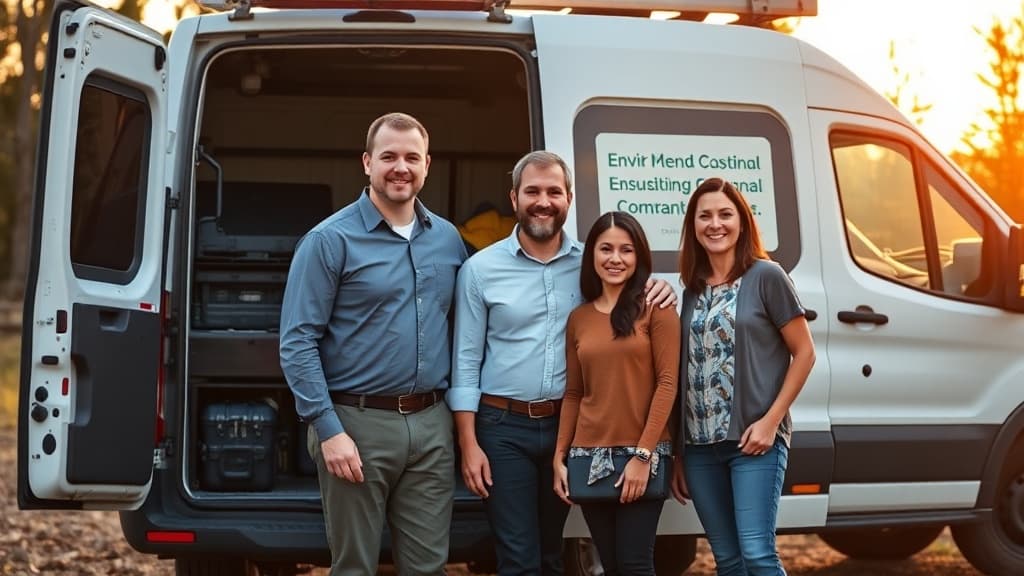
Environmental Air Solutions was founded in 2017 by Mason Bridges in Western New York. Today we run two regional offices — but our work still feels personal because it is. The same family that takes your call walks your basement, sets up the equipment, and explains the results.
That's the difference. And our customers in Buffalo, Erie, Pittsburgh, and beyond have rewarded us with a steady stream of referrals — from homeowners, real estate agents, attorneys, and home inspectors alike.
Common Questions
What people ask before they call.
Do you perform mold removal or remediation?
Are your inspectors licensed and certified?
Do you serve both New York and Pennsylvania?
How fast can you schedule a test?
Do you offer discreet testing?
Schedule · 48hr appointment
Unsure about your air? Schedule a test.
48-hour appointment window. 24-hour lab turnaround. Licensed inspectors, unmarked vehicles, statewide coverage in NY and PA.