
Testing & Inspection · NY · PA
Asbestos Testing
Pre-renovation, pre-demolition, real-estate-transaction and operations-and-maintenance asbestos surveys conducted by NYS-certified asbestos inspectors. PLM and TEM analysis through NVLAP-accredited labs. New York State updated its asbestos survey requirements in 2024 — applicability now extends beyond the original 1974 cut-off and varies by project type. Reference: NYSDOL ICR 56 clarification (2024).
Our Process · 4 steps
How asbestos testing actually runs.
- 01
Site walkthrough and suspect-material survey
- 02
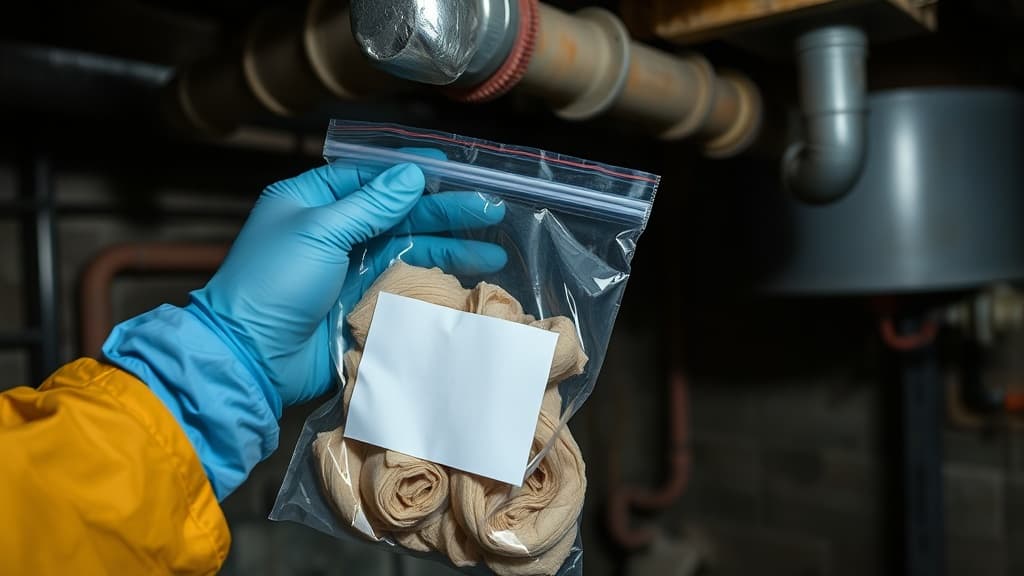
Bulk sampling with chain-of-custody documentation
- 03
Lab analysis by NVLAP-accredited partners (PLM / TEM)
- 04
Report delivery with scope of work for abatement contractor
Common Questions
About this service
What changed with NY asbestos rules in 2024?
Do I need an asbestos survey before renovating?
How long does an asbestos survey take?
When to test
Triggers + situations
Asbestos testing is required by federal AHERA regulations (40 CFR 763) before disturbing suspect materials in buildings constructed before 1989. Five specific scenarios drive most testing demand: (1) Pre-renovation surveys for any work disturbing pre-1989 building materials. Kitchen remodels, basement finishing, attic conversions, roofing, and window replacement on pre-1989 housing all require AHERA-compliant surveys. (2) Pre-demolition surveys for full or partial structural demolition. Federal NESHAP regulations require asbestos surveys before any demolition activity regardless of building age, but pre-1989 buildings carry presumed-asbestos-containing materials. (3) Real estate transactions on pre-1989 properties where buyer renovation is planned, lender requires environmental clearance, or seller chooses to document property condition. (4) Operations and maintenance (O&M) surveys for commercial property managers documenting baseline material conditions across managed inventory. (5) Litigation matters involving asbestos exposure causation, abatement compliance, or insurance-claim valuation. For routine residential transactions on pre-1989 properties without planned renovation, asbestos testing is buyer-discretionary but increasingly common as part of comprehensive environmental due diligence.
Methodology
Sampling + lab analysis options
Three analytical methods serve asbestos identification, each with specific use cases. **Polarized Light Microscopy (PLM)** is the primary method for bulk asbestos identification. EPA-approved method (EPA 600/R-93/116) using polarized light optical microscopy to identify asbestos fiber types and quantify percentage. Detection limit approximately 1%. Standard turnaround 24-48 hours. Cost-effective and appropriate for most bulk sample analysis. **Transmission Electron Microscopy (TEM)** is the confirmatory method for borderline samples and the required method for asbestos air monitoring during abatement work (clearance air samples). Higher resolution, lower detection limit (approximately 0.01%), but slower turnaround (3-7 days) and higher cost. **Phase Contrast Microscopy (PCM)** is used for asbestos fiber air monitoring (NIOSH 7400 method) — primarily during abatement work for occupational exposure monitoring, not for material characterization. For typical pre-renovation or pre-purchase surveys, PLM analysis on bulk samples is the standard and is sufficient for material characterization. TEM confirmation is selectively used for samples where PLM returns trace results or where regulatory context (e.g., schools under AHERA) requires confirmatory analysis. **Lab options:** NVLAP-accredited laboratories (NIST National Voluntary Laboratory Accreditation Program) are the standard for asbestos analytical work. We use EMSL Analytical (NVLAP Lab 200184) and RTI Laboratories among Northeast NVLAP partners.
Regulatory framework
Standards + requirements
Asbestos handling and testing is governed by an interlocking set of federal, state, and local requirements. **Federal: EPA AHERA (40 CFR 763)** establishes asbestos survey requirements for schools and federally-funded projects, defines presumed-asbestos-containing materials (PACM), and sets standards for asbestos abatement work. **EPA NESHAP (40 CFR 61 Subpart M)** governs asbestos demolition and renovation in commercial and industrial buildings. **OSHA 29 CFR 1926.1101** governs construction industry asbestos work and occupational exposure limits. **New York: NYS Industrial Code Rule 56 (ICR 56)** governs asbestos handling in NY — establishes licensed asbestos handler/inspector/contractor requirements, sample collection protocols, and abatement work-practice requirements. NYS DOL is the enforcement agency. We hold NYS DOL Asbestos Inspector license. **Pennsylvania: PA Title 25 Chapter 240** governs asbestos handling in PA — establishes licensed asbestos abatement contractor requirements and inspection standards. PADEP is the enforcement agency. We hold PA Asbestos Inspector credentialing. **ASTM E1527-21** Phase I Environmental Site Assessment standard requires identification of asbestos-containing materials as part of commercial real-estate due diligence.
Cost
What drives the price
Asbestos testing pricing varies significantly by scope: **Pre-purchase residential asbestos surveys** in our markets: $425-$675. Typical scope: 5-10 bulk samples covering vermiculite attic insulation, floor tile + mastic, pipe wrap, drywall joint compound. PLM lab analysis included. Standard 24-48 hour turnaround. **Pre-renovation residential surveys** scoped to specific work areas: $295-$525. Smaller sample counts (3-6 samples) focused on materials in the renovation footprint. **Commercial AHERA-compliant surveys** scale with building size and material inventory: $1,200-$8,500+ depending on square footage, sample point count, and analytical complexity. Schools, federally-funded buildings, and large commercial inventory may run $15,000+ for comprehensive AHERA documentation. **Pre-demolition surveys** for full structural demolition: typically scale with building size. Residential single-family $850-$1,800. Small commercial $2,500-$8,500. Large commercial $10,000+. **Sample volume multiplier:** PLM per-sample cost is $35-$55 in our lab partner network. TEM confirmation adds $75-$150 per sample. Rush turnaround adds 50-75% to base sample analysis cost. We quote firm at intake based on scope review.
Common mistakes
What to avoid
Patterns we see in asbestos testing engagements — both at the buyer level and at the practitioner level. Each pairs the mistake with the right move.
Mistake
Assuming any non-friable material is safe to disturb without testing
Correction
AHERA requires testing OR presumption of asbestos for pre-1989 materials. Non-friable status affects abatement category but not the testing requirement before disturbance.
Mistake
Insufficient sample points across material types
Correction
AHERA requires minimum 3 samples per material type for proper characterization. Single-sample assessments are not AHERA-compliant.
Mistake
DIY sample collection
Correction
Improper sampling can disturb friable materials and create exposure. Licensed inspector collection ensures methodology + chain-of-custody + safety.
Mistake
Treating PLM trace results as negative
Correction
PLM trace (below 1%) often warrants TEM confirmation, especially for friable materials or regulatory-context samples (schools, federally-funded projects).
Report contents
What you receive
The asbestos survey report we deliver includes: executive summary with AHERA category assessment per material; sample location map with photographic documentation; bulk sample analytical results (PLM + selective TEM as needed) showing fiber type and percentage; material inventory cross-referenced to AHERA presumed-asbestos-containing materials (PACM); chain-of-custody documentation; regulatory citation references (EPA AHERA, NYS ICR 56, PA Title 25 Ch 240); recommended next action (manage in place, pre-disturbance abatement requirement, full survey expansion); NVLAP-accredited lab identification with accreditation number and analyst signature. Reports support real-estate disclosure, renovation permitting, and abatement contractor scoping.
Related scope
When to bundle additional testing
Asbestos engagements frequently warrant bundling with mold testing — same site visit, combined transaction-stage report. For pre-1978 properties, lead paint testing should also be considered (XRF analysis is fast and inexpensive when bundled with the same site visit). Vermiculite-positive results often warrant additional indoor air quality testing during occupancy to assess current exposure baseline. Commercial Phase I ESA work routinely identifies asbestos survey requirements as part of the broader environmental due diligence — we scope the work in tandem.
Related Services
Often paired with asbestos testing.
Most engagements involve more than one analyte. These services are commonly scoped alongside asbestos testing.
Related reading
From our case files and guides
- GuideAIHA / NVLAP / NELAP, What Each Accreditation MeansEnvironmental labs reference different accreditations on their reports, AIHA-EMLAP, NVLAP, NELAP, EPA-ELAP. This guide explains what each accreditation actually covers, who issues them, and what they tell you about lab quality.Read it
- GuidePre-1989 Buffalo Asbestos-Containing Materials MapBuffalo NY's housing stock is among the oldest in the Northeast, with significant pre-1989 construction across nearly every neighborhood. This guide maps the typical asbestos-containing materials by construction era and neighborhood concentration.Read it
Schedule · 48hr appointment
Unsure about your air? Schedule a test.
48-hour appointment window. 24-hour lab turnaround. Licensed inspectors, unmarked vehicles, statewide coverage in NY and PA.